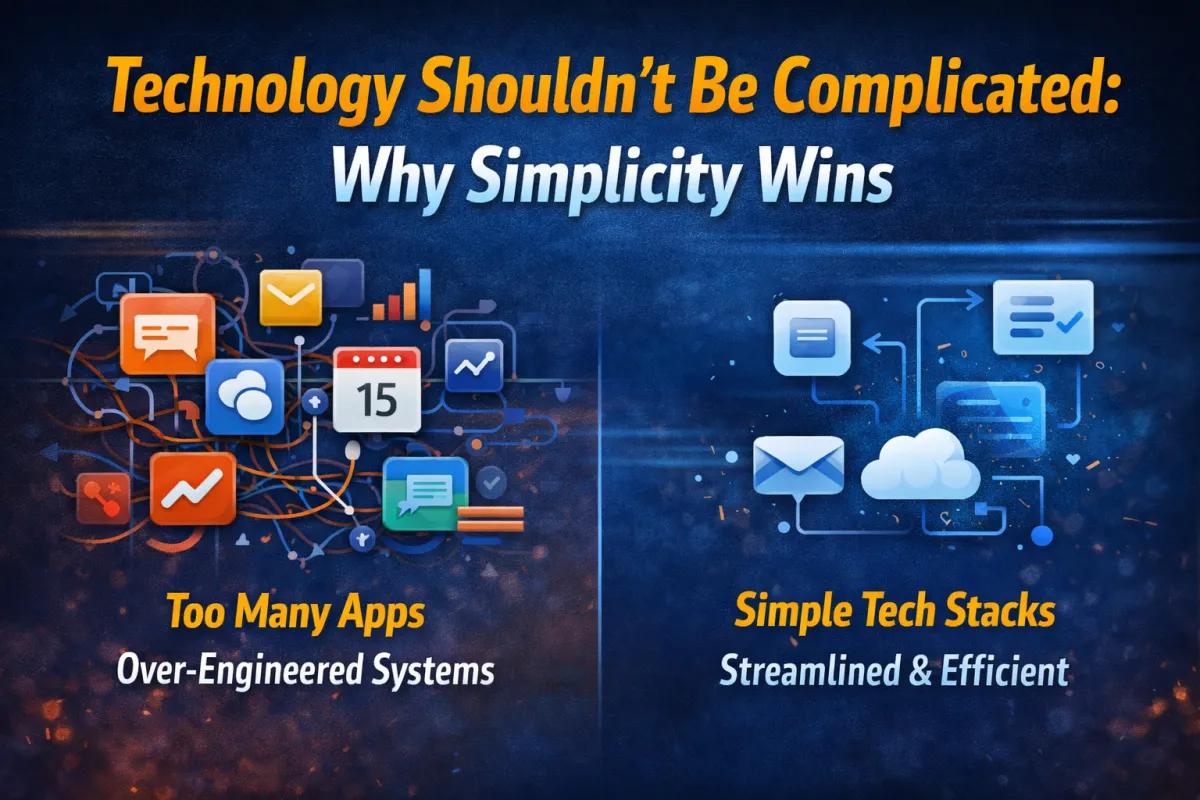
Technology Shouldn't Be Complicated: Why Simplicity Wins
Technology is supposed to make work easier.
Yet for many businesses, the opposite has happened.
Employees juggle dozens of apps. Systems require multiple logins. Processes involve copying information from one platform to another. What should be simple tasks turn into a maze of tools, dashboards, and workarounds.
Instead of speeding things up, technology often becomes the thing slowing everyone down.
The irony is that most businesses didn’t set out to create complicated systems. Complexity usually builds gradually—one tool, one app, and one “solution” at a time.
Over time, those decisions create a tech stack that feels overwhelming.
And when that happens, productivity suffers.
The Problem With Too Many Apps
Many businesses now operate with an astonishing number of applications.
Project management tools.
Communication platforms.
File storage services.
CRM systems.
Scheduling software.
Reporting dashboards.
Each one might solve a specific problem. But when too many tools are layered together, employees spend more time navigating software than doing their actual work.
Every new tool introduces another login, another interface, and another place where information lives.
Instead of simplifying work, the technology ecosystem becomes fragmented.
When Systems Become Over-Engineered
Another common issue is over-engineering.
In an effort to solve every possible problem, systems are built with so many features, integrations, and workflows that they become difficult to use.
What started as a helpful system eventually requires training sessions just to understand the basics.
Employees learn to avoid certain tools altogether because they’re simply too complicated.
The result? People revert to manual workarounds—spreadsheets, emails, and sticky notes.
The Hidden Cost of Software Bloat
Over time, organizations accumulate what could be called software bloat.
Old applications remain installed even when they’re no longer needed. Departments adopt different tools for the same purpose. Subscriptions continue long after their usefulness fades.
This creates more than just clutter.
It leads to:
• Confusion about where information should live
• Duplicate data across systems
• Higher subscription costs
• Increased cybersecurity risk
The more software a company uses, the harder it becomes to manage and secure it.
Why Simplicity Works Better
Businesses that operate with simpler technology environments often see dramatic improvements in efficiency.
When systems are streamlined:
Employees know exactly where to find information.
Tools integrate naturally with each other.
Workflows become easier to follow.
Training new team members becomes faster.
Instead of managing technology, teams can focus on the work that actually drives the business forward.
Simplicity removes friction.
The Power of a Simple Tech Stack
A strong technology strategy isn’t about using the most tools.
It’s about using the right tools—and only the ones that truly add value.
A well-designed tech stack should:
• Reduce steps, not add them
• Integrate systems so data flows smoothly
• Be easy for employees to learn and use
• Support growth without becoming overwhelming
The best systems are often the ones that feel invisible because they work so smoothly.
The Bigger Lesson
Technology doesn’t have to be complicated to be powerful.
In fact, the opposite is usually true.
The businesses that get the most value from technology are often the ones that focus on simplicity—eliminating unnecessary tools, streamlining processes, and building systems that people actually enjoy using.
When technology becomes simpler, work becomes easier.
And that’s when it finally delivers the value it was meant to provide.
A Question for You
How many different apps and systems does your team use every day?
And how many of them actually make work easier?
