What Businesses Should Expect From Their IT Provider
What Businesses Should Expect From Their IT Provider
For many businesses, IT support has traditionally been something you call when something breaks.
The server crashes.
Email stops working.
The network goes down.
You call IT, wait for someone to fix the issue, and hope everything gets back to normal as quickly as possible.
But modern businesses rely on technology for nearly everything—communication, customer service, operations, finance, and security. That means waiting for problems to happen is no longer a good strategy.
Today, a strong IT provider should do far more than troubleshoot issues. They should act as a technology partner that helps keep your business running smoothly, securely, and efficiently.
Here are a few key things businesses should expect from a modern IT provider.
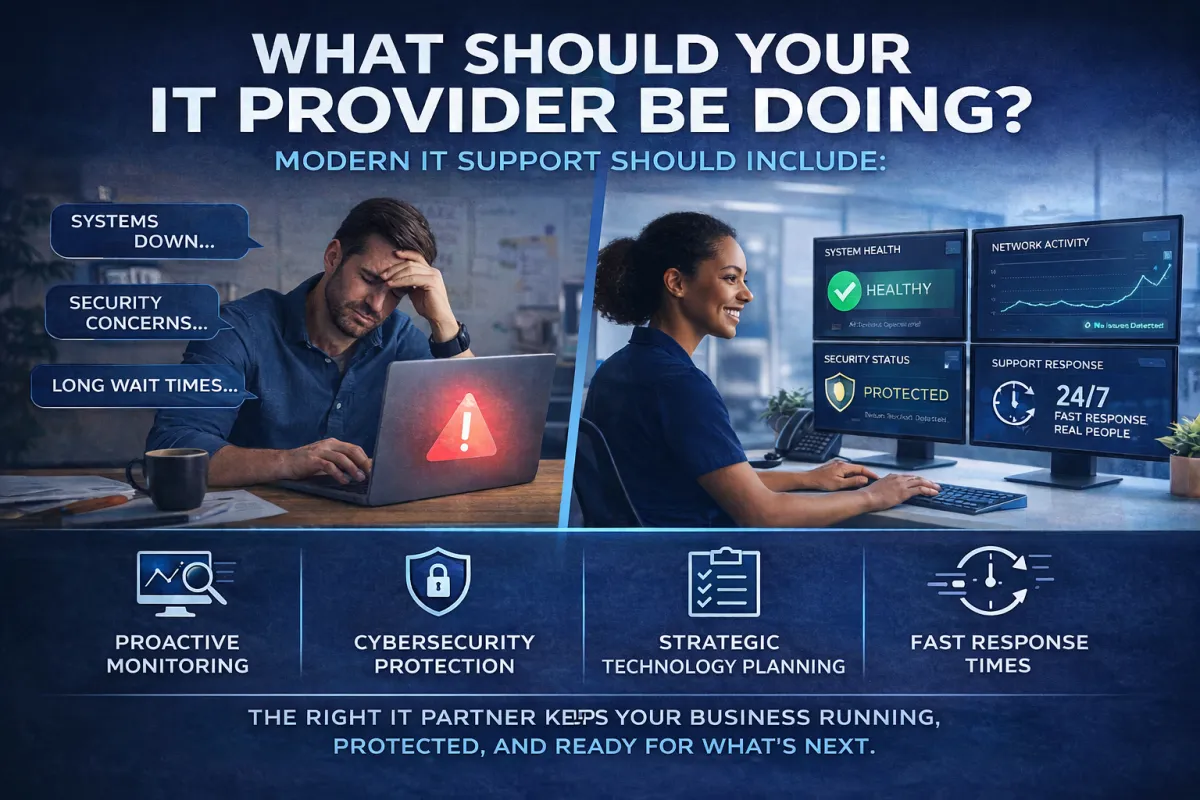
Proactive Monitoring
One of the biggest differences between traditional IT support and modern managed IT services is proactive monitoring.
Instead of waiting for systems to fail, a good IT provider continuously monitors your network, servers, and devices to identify potential issues before they become major problems.
This can include:
monitoring system performance
identifying failing hardware
detecting unusual activity on networks
ensuring backups are working properly
installing critical software updates
The goal is simple: prevent problems instead of reacting to them.
When proactive monitoring is in place, many issues are resolved quietly in the background—often before employees even notice something was wrong.
Cybersecurity Protection
Cybersecurity has become one of the most important responsibilities of any IT provider.
Cybercriminals increasingly target small and mid-sized businesses because they often have fewer defenses than larger organizations. A single attack can disrupt operations, expose sensitive data, and damage customer trust.
Modern IT support should include strong cybersecurity protections such as:
endpoint security for computers and mobile devices
email threat protection and phishing defense
firewall management
data backup and recovery solutions
multi-factor authentication (MFA)
regular security updates and patch management
Security is not a one-time setup—it requires ongoing monitoring, updates, and improvement.
An IT provider should actively help protect your systems and keep your business ahead of evolving threats.
Strategic Technology Planning
Technology decisions should not be made only when something breaks or needs replacing.
A strong IT provider should help businesses plan for the future, ensuring that technology supports long-term goals rather than becoming an obstacle.
Strategic planning may include:
evaluating current systems and infrastructure
recommending technology upgrades when appropriate
planning for business growth
improving operational efficiency through better tools
helping integrate new technology like cloud platforms or automation
Instead of reacting to problems, strategic planning helps businesses use technology as an advantage.
When technology is aligned with business goals, teams can work more efficiently and adapt more easily as the company grows.
Fast Response Times
Even with proactive monitoring and strong security, technology issues can still happen.
When they do, businesses need fast and reliable support.
Long delays in IT response can lead to:
lost productivity
frustrated employees
delayed customer service
potential revenue loss
A reliable IT provider should offer clear response times and dependable support so issues can be addressed quickly and effectively.
Responsiveness is critical because in modern workplaces, technology downtime often means business downtime.
IT Support Should Be a Partnership
Technology is no longer just a back-office function—it’s a core part of how businesses operate.
That’s why IT support should go beyond troubleshooting. The right provider acts as a trusted advisor, helping businesses maintain secure systems, improve efficiency, and plan for future growth.
At Coulson Technologies, we believe technology should make running your business easier—not more complicated.
By combining proactive monitoring, cybersecurity protection, strategic planning, and responsive support, businesses can focus on what matters most: serving customers and growing with confidence.
