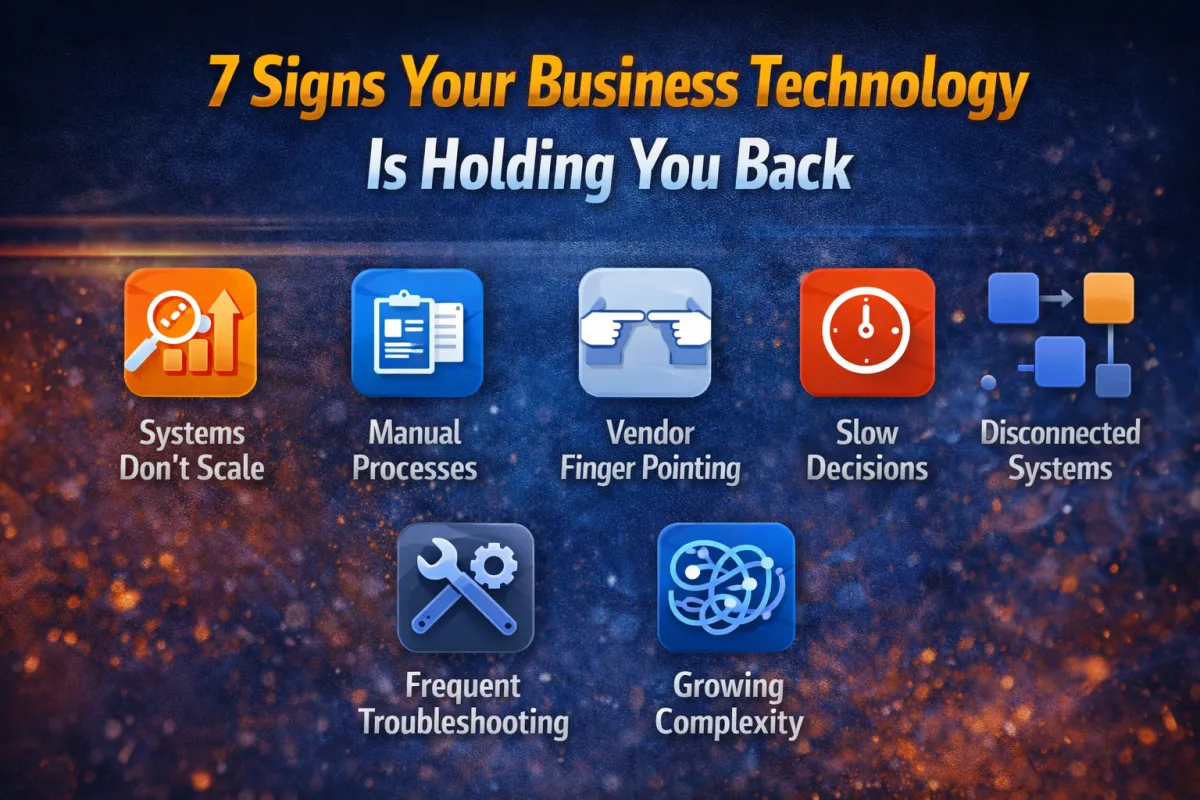
7 Signs Your Business Technology Is Holding You Back
Technology is supposed to help businesses move faster, make better decisions, and operate more efficiently.
But sometimes the systems that once supported growth quietly become obstacles.
At first, the signs are subtle. A few extra steps here. A little delay there. Teams find workarounds to keep things moving.
Over time, those small inefficiencies begin to compound. Productivity slows. Frustration grows. Opportunities take longer to pursue.
When that happens, the issue often isn’t the team—it’s the technology behind the scenes.
Here are seven signs your business technology may be holding you back.
1. Your Systems Don’t Scale as Your Business Grows
The tools that worked when your company had five employees might not work when you have twenty—or fifty.
If your systems struggle to handle more users, larger data volumes, or increased workloads, growth can quickly expose weaknesses.
Businesses often discover this when:
• Software becomes noticeably slower
• Systems crash under heavier usage
• Teams outgrow basic tools that once seemed adequate
Technology should support growth, not limit it.
2. Employees Are Creating Manual Workarounds
One of the clearest signs that technology isn’t working properly is when employees start building their own solutions.
Maybe they export data into spreadsheets because reports are difficult to generate. Maybe they manually re-enter information between systems that don’t integrate.
These workarounds may keep things moving, but they create extra work and increase the chance of mistakes.
When teams constantly invent manual processes, it’s often a sign that the underlying systems aren’t doing their job.
3. Your Tools Don’t Integrate With Each Other
Modern businesses rely on multiple platforms—CRM systems, accounting tools, communication apps, and project management software.
When those systems don’t connect, information gets trapped in separate silos.
Employees end up copying and pasting data between programs, searching for information in multiple places, or asking coworkers for updates that should be easily accessible.
Good technology ecosystems allow information to flow smoothly across systems.
4. Vendors Blame Each Other When Problems Happen
This is a common frustration in many businesses.
A problem occurs with a system. One vendor says it’s a network issue. The network provider says it’s the software. The software company points to the server.
Meanwhile, the business is left stuck in the middle.
When multiple vendors support different pieces of technology without clear coordination, resolving issues can take far longer than necessary.
A well-managed technology environment eliminates this kind of finger-pointing.
5. Decisions Take Too Long Because Data Is Hard to Access
In fast-moving businesses, good decisions depend on good information.
But when reports take hours to generate, or data lives in multiple systems, leaders often operate without the insights they need.
If teams regularly struggle to access accurate, up-to-date information, it slows decision-making and creates uncertainty.
Technology should help leaders see what’s happening in the business—not make it harder to understand.
6. Your Team Spends Too Much Time Troubleshooting Technology
When technology works well, it fades into the background.
But when systems are unreliable, employees lose time restarting computers, reconnecting to networks, or troubleshooting software.
Instead of focusing on meaningful work, teams spend time fighting with tools that should be helping them.
Those interruptions add up quickly.
7. Your Technology Feels More Complicated Every Year
Many businesses gradually accumulate new tools over time.
A new app for scheduling.
Another for communication.
Another for reporting.
Before long, employees must navigate dozens of different systems just to complete routine tasks.
Complexity grows slowly, but once it takes hold, it becomes difficult to manage.
Simpler technology environments often deliver better results because they reduce confusion and streamline workflows.
The Bigger Lesson
Technology should support your business strategy—not create friction within it.
When systems scale properly, integrate smoothly, and provide clear insights, they become a powerful advantage.
But when technology becomes overly complex or outdated, it can quietly slow growth and create unnecessary frustration.
Recognizing the warning signs early can help businesses make smarter decisions about how their technology evolves.
A Question for You
Which of these signs feels most familiar in your business?
Sometimes the first step toward improvement is simply recognizing that the systems you rely on may no longer be the systems you need.
