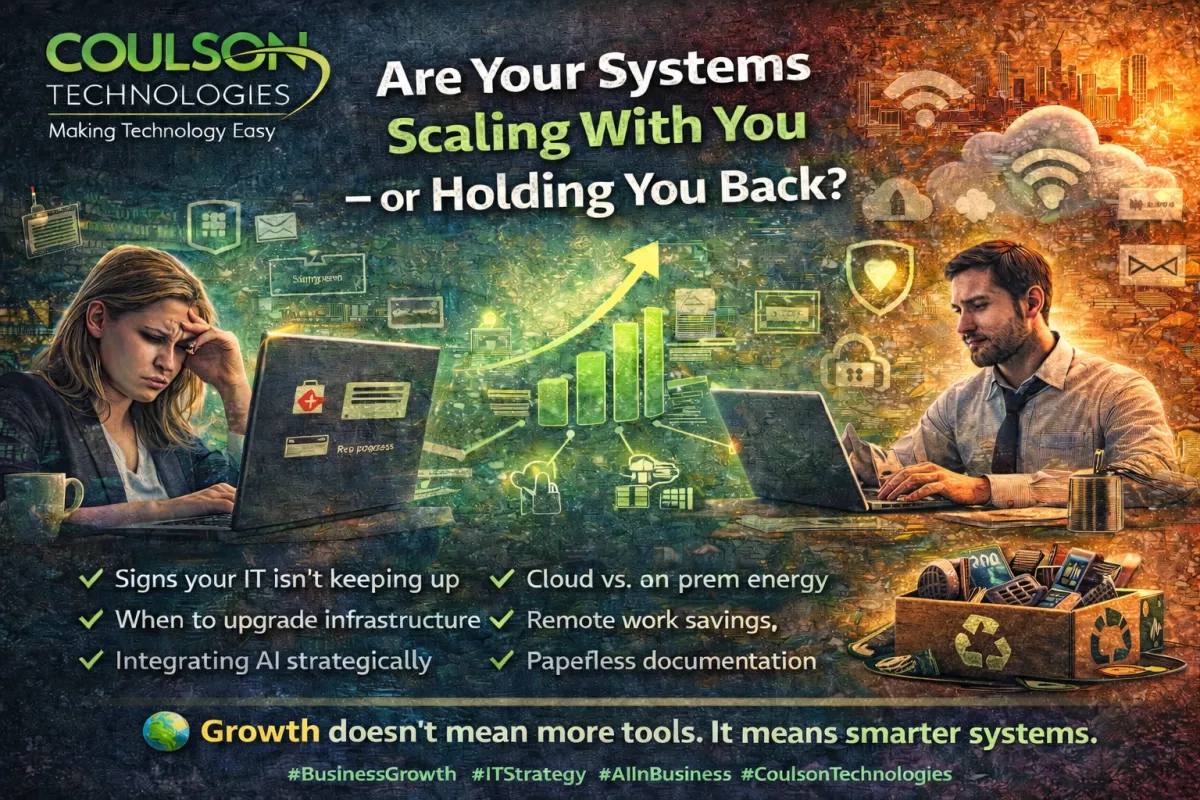
Are Your Systems Scaling With You — or Holding You Back?
Growth is exciting.
New clients.
New hires.
Expanded services.
Increased revenue targets.
But here’s the question most business leaders don’t ask soon enough:
Are your systems growing with you?
Or are they quietly becoming the bottleneck?
As Q2 planning moves forward and summer growth accelerates, now is the time to evaluate whether your technology is supporting expansion — or slowing it down.
1. Signs Your IT Isn’t Keeping Up
Most infrastructure problems don’t appear dramatically.
They show up as:
Slower response times
Frequent app freezing
Increased help desk tickets
Manual workarounds
Security alerts
Wi-Fi dead zones
Employees saying, “It’s just always been like that.”
If your team is spending time compensating for technology instead of leveraging it, your systems may already be behind.
Growth magnifies weaknesses.
2. When to Upgrade Infrastructure
You don’t upgrade because something breaks.
You upgrade when:
Your team has grown significantly
You’ve added new software tools
Data storage is expanding rapidly
You’re handling more sensitive information
Remote access demand has increased
Performance issues are becoming normalized
Infrastructure upgrades should be strategic — not reactive.
Waiting until failure costs more than planning ahead.
3. Integrating AI Strategically (Not Reactively)
AI adoption has exploded.
But growth does not mean adding more tools.
It means smarter systems.
AI fatigue is real.
Many companies are:
Testing random AI platforms
Allowing inconsistent usage
Overlapping subscriptions
Creating confusion instead of efficiency
Strategic AI integration means:
Selecting the right tools
Training teams intentionally
Setting clear usage policies
Measuring ROI
Protecting data
The goal isn’t volume.
It’s value.
4. Planning for Summer Growth
Summer often brings:
Increased project load
Seasonal hiring
Expanded marketing initiatives
New client onboarding
Ask yourself:
Can your systems handle higher traffic?
Is your cybersecurity prepared for growth?
Are remote employees supported securely?
Is your backup strategy scalable?
Growth without infrastructure planning leads to stress.
Planned growth leads to momentum.
5. Avoiding Tech Debt
Every postponed upgrade.
Every temporary workaround.
Every “we’ll deal with it later.”
That’s tech debt.
And like financial debt, it accumulates interest.
Eventually:
Security risks increase
Performance declines
Emergency fixes become expensive
Productivity suffers
Proactive IT planning prevents expensive resets.
6. Future-Proofing Your Operations
Future-ready systems:
Are scalable
Integrate smoothly
Support hybrid work
Protect sensitive data
Allow AI to enhance workflows
Reduce unnecessary tool clutter
Future-proofing isn’t about buying the newest hardware.
It’s about building infrastructure that adapts as your business evolves.
Growth Should Feel Strategic — Not Chaotic
If your systems feel stretched, slow, or fragmented, that’s not just an inconvenience.
It’s a growth limiter.
Q2 is the ideal time to evaluate:
👉 Is your technology aligned with your business goals?
👉 Or are you compensating for outdated systems?
Because scaling doesn’t mean adding more tools.
It means building smarter systems.
👉 Are your systems scaling with you — or holding you back?
Coulson Technologies helps businesses grow with confidence—aligning infrastructure, AI, and security to support long-term success.
Growth should be supported by strategy, not slowed by technology.
