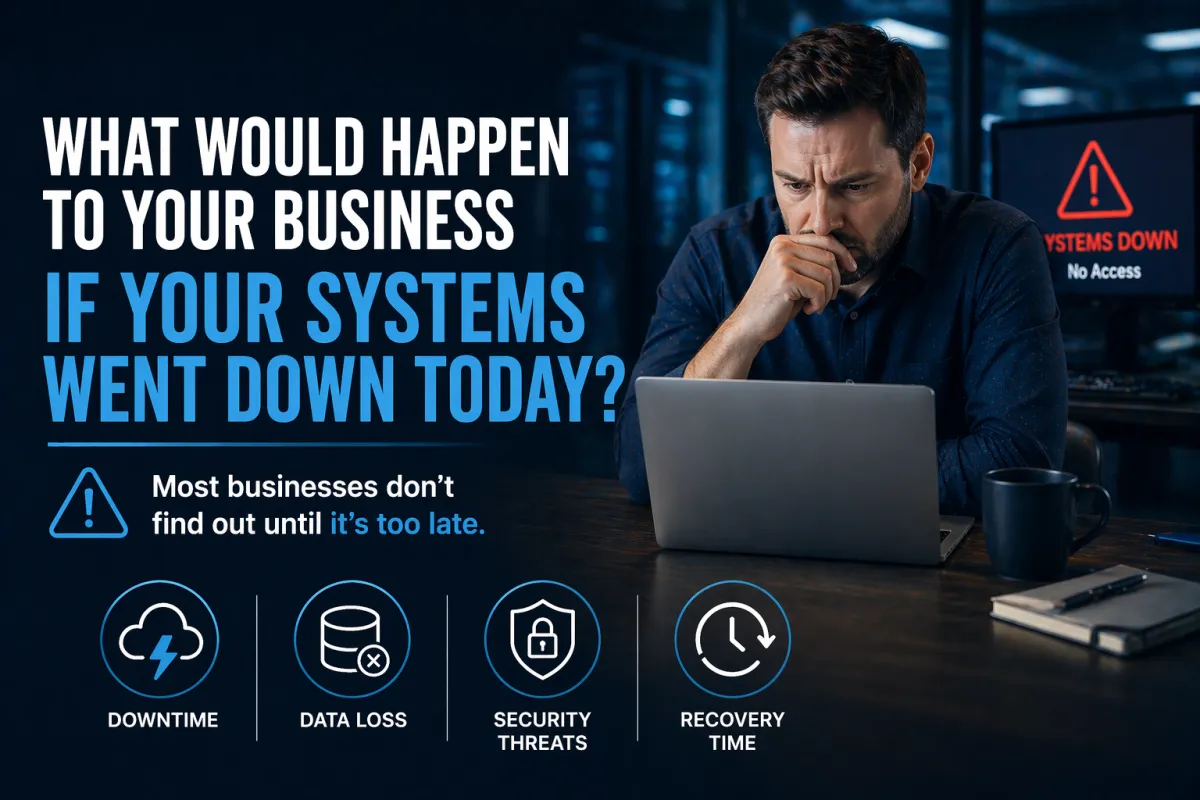
What Would Happen to Your Business If Your Systems Went Down Today?
It’s not something most businesses think about—until they have to.
A server fails.
A cyberattack hits.
Files become inaccessible.
Systems go offline.
And suddenly, everything stops.
The Reality of Downtime
When your technology goes down, it’s not just an IT issue—it’s a business issue.
Work comes to a halt.
Employees can’t access what they need.
Customers are left waiting.
Revenue is impacted in real time.
Even a short disruption can create lasting problems.
It Happens More Often Than You Think
Many business owners assume it won’t happen to them.
But downtime doesn’t just come from major disasters.
It can be caused by:
Hardware failure
Human error
Software issues
Power outages
Cybersecurity incidents
The real risk isn’t whether something will happen—it’s when.
The Cost of Being Unprepared
When businesses don’t have a plan in place, the impact is immediate.
Teams scramble to figure out next steps.
Critical data may be lost.
Recovery takes longer than expected.
And in some cases, businesses never fully recover.
That’s why the phrase holds true:
Most businesses don’t find out until it’s too late.
Backups Aren’t Enough
Many companies believe they’re protected because they have backups.
But backups alone don’t guarantee recovery.
Key questions to ask:
How recent is your backup?
How quickly can you restore it?
Where is it stored?
Has it ever been tested?
If you don’t know those answers, you may not be as protected as you think.
What Business Continuity Really Means
It’s not just about recovering data—it’s about keeping your business running.
A strong plan includes:
Reliable backups
Clear recovery processes
Defined roles and responsibilities
Systems designed to minimize downtime
Because the goal isn’t just to fix the problem—it’s to keep operations moving.
A Simple Question to Consider
If your systems went down right now…
How long could your business operate?
An hour?
A day?
A week?
Your answer says everything.
Final Thought
Downtime isn’t a possibility—it’s an inevitability.
The difference is how prepared you are when it happens.
Because when your systems go down, you don’t want to be figuring it out in the moment.
You want to already have the answer.
